What is a folded self-mailer?
Discover the benefits of folded self-mailers and how they can enhance your direct mail campaigns. Learn design tips and automation strategies.
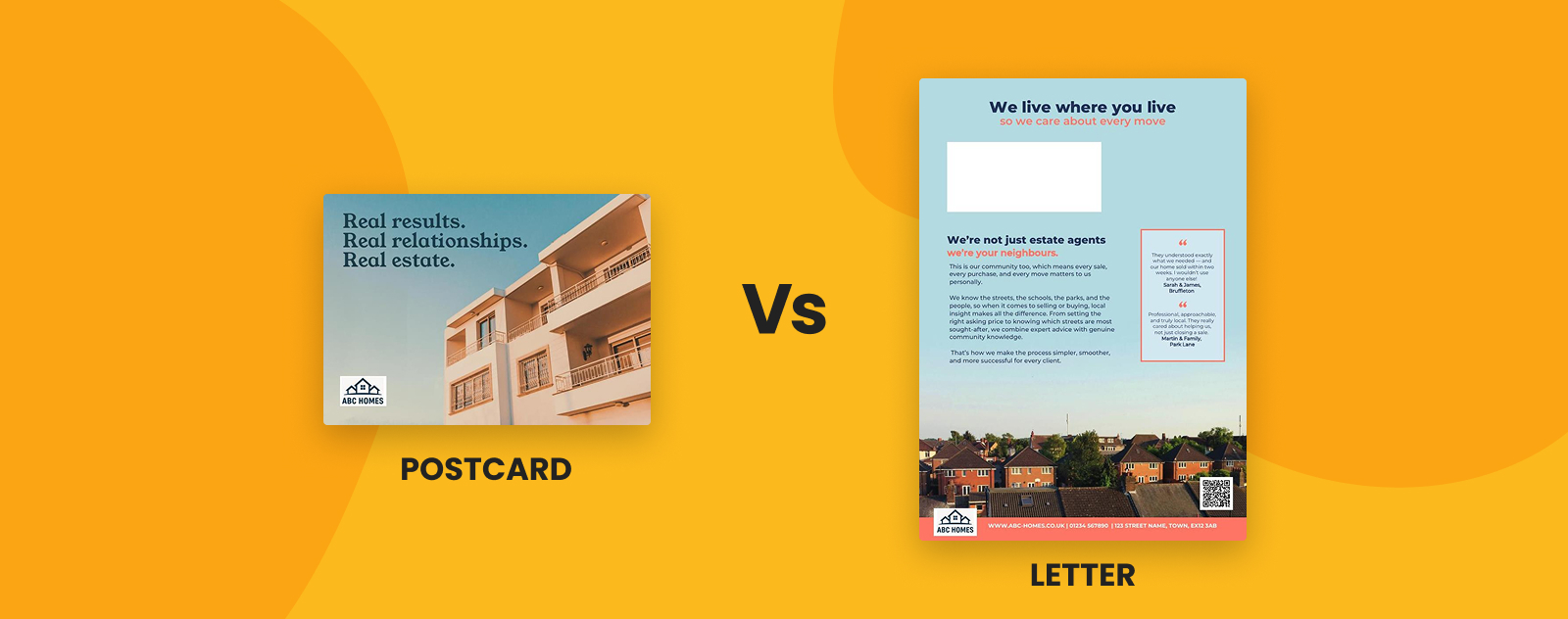
Postcards get seen the moment they land. Letters have to be opened first, and that's the whole difference between the two formats. It's the first thing to understand before you choose one for your next campaign.
Both work. Neither is universally better. The right choice depends on your message, your offer, and how much explaining you actually need to do. Here's how to decide.
A postcard is a single flat piece, printed both sides, no envelope required. It's designed to be seen instantly. The recipient doesn't choose whether to engage with it the way they choose whether to open an envelope.
A letter is enclosed correspondence, usually printed on one or both sides and folded into a window or non-window envelope. It carries a different tone: formal, personal, official. The recipient has to make a small decision (open or bin) before they see a word of the message.
That one extra step, the decision to open, is the whole story behind why these two formats perform differently.
Postcards typically post a slightly higher response rate than letters, largely because the message is visible without any action required. According to the ANA/DMA Response Rate Report, postcards and letter-sized mail both perform well against digital channels, with format differences generally running in the low single digits rather than being dramatic.
That's a smaller gap than most marketers expect. The bigger driver of response isn't postcard versus letter, it's list quality, offer strength, and targeting. Format is a genuine variable, but it's rarely the difference between a campaign that works and one that doesn't.
Where the format gap does widen is on cold, unfamiliar audiences. A postcard's visibility matters more when the recipient has no existing relationship with you. A letter's formality matters more when the message needs to be taken seriously on first contact, like a compliance notice or an appointment reminder.
Postcards are the right call when:
Because there's no envelope to design or fill, postcards are also the faster format to get to market. If you're testing a new offer or a new list, a postcard is the lower-risk way to find out what works before committing to something more involved.
Letters make more sense when:
A letter's enclosed nature also matters for privacy. Financial services, healthcare, and legal communications often default to letters precisely because the content shouldn't be visible to anyone else in the household before the recipient opens it.
Not really, and that's worth knowing. Both formats support full personalisation, from a first name in the headline to entirely different images and offers per recipient. With Stannp.com, that costs exactly the same whether you're sending a postcard or a letter, so personalisation shouldn't be a factor in choosing between them.
What personalisation does do is lift response on whichever format you choose. A postcard that opens with a recipient's name, a relevant offer, and a nearby location reference will consistently outperform a generic version of the same postcard. The same is true for letters.
Postcards are generally the cheaper option per piece. There's no envelope to buy, no folding, no enclosing step, and printing is typically simpler since it's a single flat sheet. For high-volume campaigns, that difference adds up quickly.
Letters cost more, largely because of the extra production steps, folding, enclosing, and the envelope itself. That additional cost is usually justified by the context: a letter reaches audiences and use cases where a postcard would feel out of place, regardless of the modest price difference.
Neither format has a minimum order with Stannp.com, so testing either one on a small batch before committing to a full campaign costs very little either way. To work out the cost of your send, check out our pricing calculator.
Yes, and it's often the smartest option. A common sequence looks like this: an initial postcard to introduce an offer or generate awareness, followed by a letter for recipients who showed interest but haven't converted, this time with more detail, a formal tone, and a stronger call to action.
A quick way to think about it: if your message can be summarised in one sentence and a strong visual, send a postcard. If it needs paragraphs, a form, or a formal tone to land properly, send a letter.
Beyond that, the only reliable way to know which format your specific audience responds to is to test it. Send both formats to a clean 50/50 split of the same list, track a single consistent action (a QR scan, a personalised URL, a promo code), and let the results tell you which one to lean on going forward. Our guide to A/B testing in direct mail covers exactly how to set this up properly.
Ready to test both formats without committing to a big print run? Create your free Stannp.com account and send a small batch of each to see what your audience actually responds to.

Neither is universally better. Postcards tend to edge out letters on response rate because there's no envelope to open, but letters suit messages that need space, privacy, or a formal tone. The right choice depends on your offer and audience.
Often, yes, though the gap is usually modest rather than dramatic. According to the ANA/DMA Response Rate Report, format differences are real but tend to matter less than list quality and offer strength.
Generally, yes. Letters involve an envelope, folding, and enclosing, which adds production cost compared to a single flat postcard. The difference is usually small per piece but adds up at volume.
Yes. Both formats support full variable data, images, offers, and messaging tailored per recipient. With Stannp.com, personalisation costs the same regardless of which format you choose.
Letters. The enclosed format protects privacy and signals a level of formality that postcards, by design, don't offer.
Yes, if you can. A small, clean 50/50 split test across the same list, with everything else held constant, is the most reliable way to find out which format your specific audience responds to.
Discover the benefits of folded self-mailers and how they can enhance your direct mail campaigns. Learn design tips and automation strategies.
Discover how A/B testing in direct mail can enhance your campaigns by identifying what truly resonates with your audience for improved results.
Discover why relying solely on demographics for marketing isn't enough. Learn how behavioural data can enhance targeting, timing, and messaging in...