Summer direct mail campaigns: ideas, timing, and what actually works.
Unlock the potential of your summer direct mail campaigns with effective timing, tailored messaging, and proven strategies for maximum impact.
Most people using AI to write direct mail copy are getting mediocre results and blaming the tool. The tool isn't the problem. The brief is.
AI is only as good as the instructions you give it. Send it a vague request and you'll get vague copy: competent, inoffensive, and completely forgettable. Give it a proper brief and you'll walk away with headlines, body copy, image direction, and a psychological framework, all from a single prompt. The difference isn't which AI tool you use. It's knowing how to ask.
Type "write a postcard for my furniture sale" into any AI tool and you'll get something that could belong to anyone. There's no offer, no audience, no tone, no reason to act. The AI isn't being lazy. It just doesn't know what you know.
It doesn't know your customer. It doesn't know your offer. It doesn't know what makes your brand different from every other furniture business that's ever sent a postcard.
Your prompt is the brief. And like any creative brief, a thin one produces thin work. Write a rich one and you can walk away with everything you need: copy, layout guidance, image direction, and the psychological framing to make it land. All in one go.
Think of every prompt in four parts: Role, Context, Task, and Format. Get all four right and you'll rarely need more than one refinement pass.
Don't ask AI to write generically. Give it a persona that matches your goal.
For B2C: "Act as a direct mail copywriter with 15 years of experience in retail promotions..."
For B2B: "Act as a B2B marketing strategist writing a prospecting letter for professional services firms..."
This anchors the tone, the vocabulary level, and the strategic instincts behind every word it produces. It's the difference between a generic response and one that actually sounds like it came from someone who knows the channel.
This is where most prompts fall short. The more context you give, the better the output.
Cover these:
Add what you want the copy to do and what to avoid. If you have tone-of-voice guidelines, drop them in. The more the AI understands your audience and constraints, the less you'll need to revise.
Here's where you move from acceptable copy to genuinely persuasive copy. Ask AI to apply proven influence frameworks directly in its output.
Cialdini's six principles translate naturally to direct mail:
For a deeper look at how these principles work in direct mail, the psychology of influence in direct mail is worth reading before you build your next prompt.
AIDA (Attention, Interest, Desire, Action) is a natural structure for postcard copy: a headline that stops the eye, body copy that builds want, and a CTA that removes friction.
SPIN (Situation, Problem, Implication, Need-payoff) works particularly well for B2B letters, where you need to move a reader from vague awareness to clear conviction that they need what you offer.
Your task instruction might read: "Write the front headline and back body copy for this postcard. Use an AIDA structure. Apply scarcity and social proof from Cialdini's principles. The headline should be benefit-led and no longer than 10 words."
If you want to understand how colour choices can reinforce these psychological triggers, the power of colour psychology in direct mail covers how to make design and copy work together.
Tell the AI what to deliver so you get something usable, not a wall of undifferentiated text.
"Provide: (1) three alternative headlines for the postcard front, (2) body copy for the reverse in under 80 words, (3) three CTA options, (4) a suggested image direction for the front, and (5) any colour or layout notes that would reinforce the message."
Ask for image direction and you're not just getting copy. You're getting a mini creative brief that keeps your design coherent with your message. That's everything you need to brief a designer or build your campaign directly in Stannp.com's design tool.
Here's what all four layers look like in practice. Copy it, adapt it, use it:
Act as an experienced direct mail copywriter specializing in B2C retail. I'm creating a 6x9 postcard campaign for lapsed customers of a premium pet food brand. The recipient last purchased six months ago and owns at least one dog. The offer is a free bag of our new grain-free treat range with their next order over $45, valid for 21 days. The campaign goal is to reactivate purchasing.
Apply AIDA structure across the front and back of the postcard. Use Cialdini's principles of scarcity (limited availability of the free bag) and reciprocity (we're giving something before asking for anything). The tone should be warm, slightly playful, and confident. Not pushy.
Please provide: three headline options for the front (under 10 words each), body copy for the reverse (under 90 words), two CTA options, a direction for the front image, and any notes on layout emphasis that would strengthen response rates.
One prompt. Everything you need to brief a designer or get started in Stannp.com's editor, without a single back-and-forth.
Even a strong prompt sometimes needs one follow-up. Use it strategically:
What you're not doing is iterating vaguely. "Make it better" or "try something different" wastes everyone's time, including the AI's. Every refinement should be as specific as the original brief. One targeted follow-up is all a well-structured prompt should ever need.
AI is a powerful starting point, not a finished product. Before your mail goes anywhere near a letterbox:
The goal is to arrive at excellent faster, not to remove human judgment from the process.
One final thing worth knowing: a single AI query uses roughly 10–20 times the energy of a standard search engine query. Spending a little more time crafting a thorough prompt rather than sending ten vague ones is better for your output and better for the planet.
To show the difference, here's a real example. The same brief, two different approaches.
Weak prompt: "Design me a postcard. Sending to consumer customers, I run a furniture business, and I want to send mail that gets people interested in visiting my website and buying my pieces."
Result: the AI came back asking for the furniture style and a website URL. Two rounds of back-and-forth just to get started, and the output was still generic.
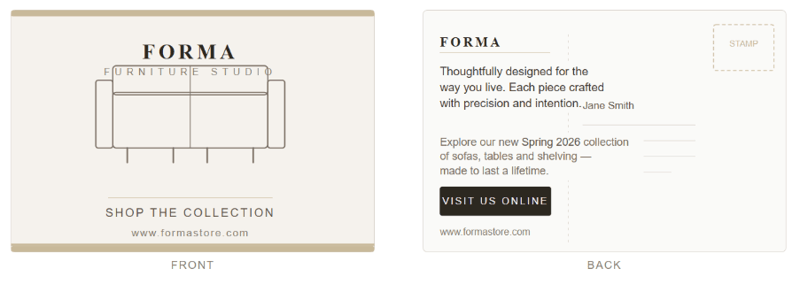
Strong prompt (single message, no follow-up needed):
Act as a B2C modern furniture business, and a marketing leader creating and sending a strategic business marketeer with strong copy writing experience.
Design me a postcard. Sending to consumer customers that will get people interested in visiting my website and buying my pieces. The language should be warm in nature but clear and persuasive. The recipients are adults, they take pride in their home and care about the furniture that is in it, used by them, and used by friends and family. Gender agnostic but equal in their love of great furniture, that looks expensive whilst offering affordability. As a minimalist furniture brand, they may also be interested in clean, timeless designs that are well made and offer a great base for further interior design additions to the space.
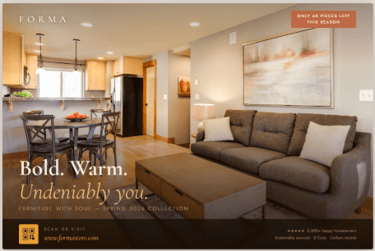
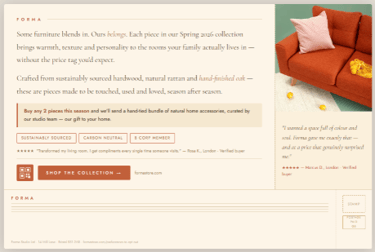
Consider AIDA that includes a building story that immediately gets attention with 2-3 attractive modern minimalist furniture items on the front, spark further interest, then moves to the back of the postcard with more copy that entices the recipient towards a positive decision, and directs them clearly to action. Add a CTA on the front with a QR code, and another on the back with a QR code. Consider also using principles of persuasion in the overall mail design and copy. I like social proof, endorsements around ethical and sustainable practices, and perhaps some form of scarcity offer linked to the exclusivity of fewer pieces available. Not money off necessarily, but perhaps an additional gift for a number of purchases.
Provide a calming design option with natural and neutral colours (such as greens, and beiges) and another that is a little more colourful, still with natural colours (North African terracotta style palates).
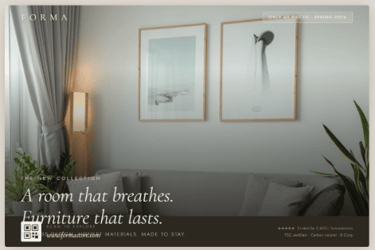
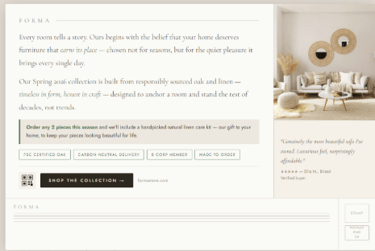
The output was two fully art-directed postcard concepts, each with a distinct visual direction, ready to brief a designer or adapt directly in Stannp.com's editor.
Ready to put it into practice? Create your free Stannp.com account and build your next campaign directly in the platform.

Yes. The Role, Context, Task, Format framework works regardless of sector. The key is specificity in the Context layer. A financial services letter needs different audience insight than a retail postcard. Give the AI the same detail you'd give a human copywriter and the output will reflect it.
No. The prompting principles here work with ChatGPT, Claude, Gemini, Perplexity, and most other large language models. The quality of the output depends far more on the quality of the prompt than the choice of tool.
As long as it needs to be to cover Role, Context, Task, and Format properly. For a straightforward postcard campaign, 150–250 words is usually enough. For a complex multi-audience letter, you might go longer. Don't pad it, but don't cut corners on the Context layer either.
For a first draft, it can get you a long way. For a finished piece that's genuinely on-brand, has been fact-checked, and has had a human eye on the compliance, no. Think of it as a very fast junior writer that needs a senior sign-off before anything goes to print.
Only if the brief was generic. A well-prompted, well-edited piece of direct mail that's personalized to the recipient with a relevant offer won't feel AI-generated. What feels generic is copy that could have been written for anyone. That's a brief problem, not an AI problem.
Ask for image direction and layout notes in the Format layer of your prompt. When copy and design are briefed from the same creative direction, they reinforce each other. Stannp.com's in-platform editor lets you build the piece directly once you have the copy and direction, with no separate design tool needed.
AI can write personalized copy at the template level: copy structured around merge fields like first name, last purchase, or a custom offer. For piece-level personalization at scale, that's where Stannp.com's variable data printing comes in, letting you customize every single piece without paying extra for it.
Unlock the potential of your summer direct mail campaigns with effective timing, tailored messaging, and proven strategies for maximum impact.
Discover how to boost seasonal marketing with direct mail that cuts through digital noise, connects emotionally, and drives real results. Make every...
Unlock the full potential of your campaigns with features like automation, personalization, and more for higher ROI and engagement.