How to measure direct mail ROI: tracking, attribution, and proving results.
Discover how to effectively measure direct mail ROI with tracking methods, attribution techniques, and practical insights to prove your campaign's...
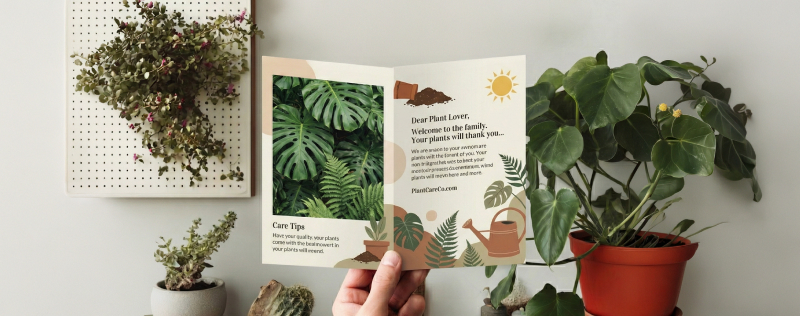
Most direct mail falls into two camps: postcards that get read immediately but don't say much, or letters that say plenty but need opening first. Self-mailers (or greetings cards as they're called in the UK) sit right in the middle, and that's exactly why they work.
A self-mailer is a piece of mail that's folded and sealed without an envelope. Think of it as a postcard's more sophisticated sibling. You get multiple panels to work with, your branding is visible the moment someone pulls it from their mailbox, and there's no stuffing envelopes at 11pm the night before your campaign launches.
Whether you're new to this format or looking to enhance your mail strategy, here's everything you need to know.
The whole point of a self-mailer is immediacy with substance. A postcard catches attention but runs out of space fast. A letter has room to breathe but hides behind an envelope. Self-mailers let recipients see your message without extra steps, while giving you enough panels to actually say something useful.
That matters more than you'd think. When someone's sorting through mail, they're making split-second decisions about what deserves attention. An envelope might get opened later (or never). A postcard gets three seconds of attention. A self-mailer unfolds naturally as they look at it, revealing more information without requiring commitment.
Don't use self-mailers just because they look nice. Use them when you need to show something that requires a bit of room to breathe but can't afford to be ignored.
Product launches work well because you can dedicate different panels to features, benefits, and a clear next step. One panel for the hero shot, another for the details, a third for the offer or QR code.
Event invitations benefit from the format too. Front panel grabs attention, inside panels cover date/time/location/agenda, back panel has the RSVP mechanism. It's more substantial than a postcard but doesn't feel as formal as a letter.
Onboarding sequences are another strong use case, particularly if you're introducing a product or service that needs some explanation. You can walk someone through information without overwhelming them on a single side.
Reactivation campaigns can work because you have space to acknowledge the lapsed relationship and present a compelling reason to come back. "We noticed you haven't been in for a while" needs more nuance than a postcard allows.
Self-mailers struggle with purely transactional mail (invoices, statements) where a letter makes more sense, and with ultra-simple messages where a postcard does the job more cost-effectively. But for local businesses, the format provides enough space to showcase their offering while maintaining visibility.
Design gets all the attention in direct mail conversations, but automation determines whether campaigns actually happen. Self-mailers work particularly well in automated workflows because they're substantial enough to justify the trigger but not so complex that fulfillment becomes a headache.
With Stannp.com, you can connect your CRM and set up self-mailers to send automatically based on customer behaviour. Abandoned cart after 48 hours? Trigger a mailer. Customer hasn't purchased in 90 days? Send a win-back piece. Someone just signed up but hasn't activated their account? Follow up with more information.
The API handles the heavy lifting. Your system detects the trigger, sends the data, and the mail goes out without anyone manually uploading CSVs or checking print queues. For businesses sending dozens or hundreds of triggered pieces per day, that automation matters more than having the perfect color gradient on your design.
Most design advice for self-mailers focuses on making things pretty. That's fine, but pretty doesn't necessarily perform. Focus on these instead:
Lead with a clear visual hierarchy. Someone should understand your main point in three seconds. If they're still squinting at your first panel trying to figure out what you're selling, you've already lost.
Each panel should have a job. Don't just fill space with generic brand messaging. Panel one grabs attention. Panel two explains the offer or problem. Panel three provides proof or details. Panel four drives action. Give each section a specific purpose.
Personalization matters, but not everywhere. Adding someone's name to the greeting is expected. More interesting: personalize the offer based on their purchase history, or the imagery based on their location, or the messaging based on where they are in your funnel. Stannp.com makes variable data simple enough that you should be using it for more than just "Dear ."
Your call-to-action needs to be obvious. Put it in multiple places. Make it clear what happens when someone scans the QR code or visits the URL. "Learn more" is weak. "Get 20% off your next order" or "Book your free consultation" tells them exactly what they're getting.
One thing to be cautious of: cramming too much into a self-mailer because you finally have the space. Don't. More panels doesn't mean you should use all of them to their maximum capacity. White space improves readability more than adding another product shot.
Self-mailers cost more than postcards and letters. Whether that's worth it depends entirely on what you're trying to accomplish.
If you're sending a purely awareness mail piece to cold prospects, postcards are probably smarter. If you're sending something transactional or highly personalised, letters make more sense. Self-mailers shine when you need the middle ground: enough substance to be taken seriously, enough immediate visibility to avoid the "I'll open it later" pile.
The real cost consideration isn't price per piece, though. It's cost per result. Do the math on your own numbers rather than optimizing for the lowest unit cost.
Setting up self-mailers in Stannp.com is straightforward. Upload your design as a PDF with the panels laid out correctly (we have design guides if you're not sure), connect your mailing list, and either send immediately or set up automation rules.
The address verification runs automatically on every upload, catching issues before mail goes out. That cuts mailing costs by preventing undeliverable pieces. Not exciting, but it adds up fast when you're sending thousands of pieces.
If you're running campaigns across multiple channels, integrating with your CRM or analytics platform lets you see direct mail performance alongside email, social, and everything else. Most businesses find this essential for understanding which channels are actually driving results.
Self-mailers aren't revolutionary. They're just a format that happens to work well when you need something between a postcard and a letter. Use them when that's what your campaign actually needs, not because they're trendy or because everyone else is using them.
The format matters less than the strategy behind it. Sending random self-mailers to random people with random messaging won't work any better than random postcards or random letters. Figure out what you're trying to accomplish, who you're targeting, and what you want them to do next. Then pick the format that makes that easiest.
Order samples to see the quality, or log into your account and set up a small test campaign. Start with 100-200 pieces to a segment you know well, measure the results, and scale from there if it works.
Discover how to effectively measure direct mail ROI with tracking methods, attribution techniques, and practical insights to prove your campaign's...
Discover why relying solely on demographics for marketing isn't enough. Learn how behavioural data can enhance targeting, timing, and messaging in...
Unlock the potential of your summer direct mail campaigns with effective timing, tailored messaging, and proven strategies for maximum impact.